
Cellular vitality
Below is an overview of the research on the effects of Analemma Water on organ-specific cell cultures. This study looked at measurable changes at the cellular level, with special attention to the intestinal barrier, cell metabolism, regeneration, oxidative stress and the activity of functional immune cells.
Cellular vitality & intestinal barrier
Analemma Water shows positive effects on cellular processes in intestinal cells
RESEARCH:
Animal-free cell biological testing methods conducted by Dartsch Scientific GmbH, Germany.
CELL MODELS:
Two types of organ-specific cell cultures were used: intestinal epithelial cells and functional neutrophils. Intestinal epithelial cells are an important model for the intestinal barrier. Neutrophils are immune cells involved in primary, innate defense.
STUDY UPDATE:
Fresh local tap water was compared with the same water after being treated with the Analemma Water Rod for 1 minute. Both water samples were added to cell culture media or reaction mixtures at concentrations ranging from 0 to 40 percent by volume.
RESULTS:
Compared to the original tap water, Analemma Water showed several statistically significant differences in the cell models:
- average 22.8% higher stimulation of cell metabolism in intestinal epithelial cells;
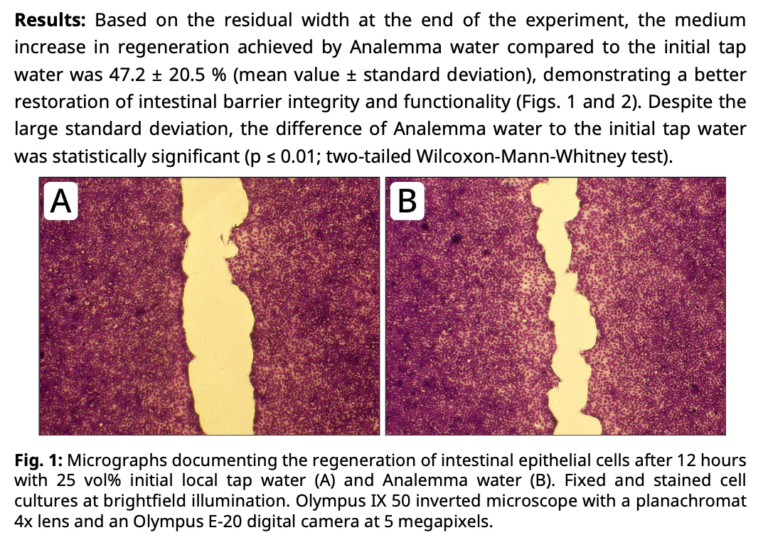
- mean 47.2% higher regeneration of intestinal epithelial cells;
- 25.8% average improved cell viability under oxidative stress;
- 23.0% higher average formation of superoxide anion radicals by functional neutrophils at 10 to 40 volume percent.
CONCLUSION:
The study shows that Analemma Water had measurable positive effects on various cellular processes in this laboratory setup. The results around intestinal epithelial cells were particularly striking: the cells showed higher metabolic activity, better regeneration and greater resistance to oxidative stress. In addition, the results in neutrophils indicated increased activity of a process belonging to primary innate defense.
View the cell culture study
What do we mean by cellular vitality?
Our body is made up of billions of cells that are constantly active. Each cell needs energy, communicates with other cells, repairs itself and responds to stimuli from the environment. Consider intestinal cells, for example: together they form an important barrier between the outside world and the inside of the body. These cells help with absorption, protection, communication and balance.
When cells function properly, they can perform their daily tasks more efficiently. They produce energy, repair damage and remain more resistant to influences such as oxidative stress. Oxidative stress occurs when reactive oxygen compounds disrupt the cell’s natural balance. In laboratory research, this can be simulated in a controlled manner to see how well cells continue to function under pressure.

Our cells use the energy released from the breakdown of ATP to perform their biochemical tasks, such as building new molecules or breaking down old ones. This constant chemical exchange ensures that our bodies function optimally, with ATP powering every contracting muscle, every active nerve cell and every thought, step, breath and movement.
A crucial role of ATP is DNA synthesis. Every time one of our cells divides and forms two genetically identical daughter cells, the DNA must be copied. The energy that maintains this complex process is released from the breakdown of ATP. But there is more. ATP is also one of the 4 main components that make up the DNA molecule – it is literally woven into our genetic makeup. Without ATP, we would not exist.
The intestinal barrier as the first line of defense
The intestinal wall is much more than just a passageway for nutrients. It is a living, active tissue that is constantly renewing. Intestinal epithelial cells form a protective layer that helps determine what is and is not allowed to pass through. Therefore, a strong and functioning intestinal barrier is important for the overall balance of the body.
The study looked at how intestinal epithelial cells responded when Analemma Water was added to the cell medium. The results showed that, on average, the cells showed more metabolic activity. It was also seen in a regeneration model that the cells more rapidly colonized the open area in the cell culture, an indication of enhanced repair activity in this test setup.
Protection in oxidative stress
Another part of the study focused on oxidative stress. This involved exposing intestinal cells to hydrogen peroxide, a substance often used in laboratory research to mimic oxidative stress. It was then measured how many cells remained vital.
Neutrophils and innate defenses
In addition to intestinal cells, functional neutrophils were also examined. Neutrophils are white blood cells that are part of the innate immune system. They can form reactive oxygen compounds as part of their natural response to unwanted invaders.
In the study, Analemma Water was seen to slightly stimulate the basal metabolism of these cells, but this difference was not statistically significant. In contrast, superoxide anion radical formation increased on average by 23.0% at the concentrations tested from 10 to 40 percent by volume, and this difference was statistically significant. According to the report, this may indicate possible support for the primary innate defense function of neutrophils within this laboratory model.

What did the research show?
This study shows that Analemma Water caused measurable differences in animal-free cell models compared to the original tap water. The main observations were higher metabolic activity, stronger regeneration, better cell survival under oxidative stress and increased functional response of neutrophils.
The study thus shows that, in this controlled laboratory setting, Analemma Water affected cellular processes related to energy, repair, protection and primary defense activity. These are cellular-level results, not a clinical study in humans. Therefore, the results are particularly interesting as an indication that coherent water can measurably influence biological processes in cellular models.
Conclusion
Dartsch Scientific’s results show that Analemma Water showed positive effects on intestinal epithelial cells and functional neutrophils compared to untreated local tap water. Especially the combination of increased cell metabolism, improved regeneration and better resistance to oxidative stress makes this study relevant within the broader research on coherent water.
In simple words, in this cell study, the cells studied responded more vital, resilient and active when Analemma Water was applied. This supports the hypothesis that stable coherent water is not just a transport medium, but in cell models can be measurably related to biological processes of energy, repair and balance.
Main substantiation from the report: cell metabolism increased on average by 22.8 ± 6.5% and was statistically significant; regeneration increased on average by 47.2 ± 20.5%; under oxidative stress, cell viability was 25.8 ± 13.0% higher; and superoxide formation by neutrophils increased on average by 23.0 ± 4.2% at 10-40 vol%, also statistically significant.