
NMR / FT-IR
Below is an overview of Full Spectrum Coherent Water research with NMR and FT-IR: two modern measurement methods that help look at the subtle structure and motion of water molecules.
Water structure in view
What do NMR and FT-IR tell us about coherent water?
WHAT IS WATER STRUCTURE?
At first glance, water seems very simple: H₂O. Yet water is much more dynamic than that simple formula suggests. Water molecules are constantly interconnected via hydrogen bonds. You can think of this as an ever-moving network in which molecules attract, release and rearrange each other.
It is precisely this network that determines much of the behavior of water. It is not just the individual water molecules that are interesting, but especially the way they form temporary structures or clusters together. This study looked at whether water exposed to the Analemma Water Inlay for 10 minutes was measurably different from untreated distilled water.
Looking at water without touching it
Two measurement methods were used in this study: Nuclear Magnetic Resonance, NMR for short, and Fourier Transform Infrared Spectroscopy, FT-IR for short.
NMR looks at the environment of hydrogen particles in water. When that environment changes, it can be visible as a small shift in the measurement signal. FT-IR instead looks at how water absorbs infrared light. The region in which O-H bonds vibrate is particularly interesting in this regard, because it tells a lot about hydrogen bonds.
Together, these methods provide a window into the behavior of water: how water molecules relate to each other, how dynamic the network is, and whether there is evidence of cluster structures.
NMR
A measurable difference between treated and untreated water
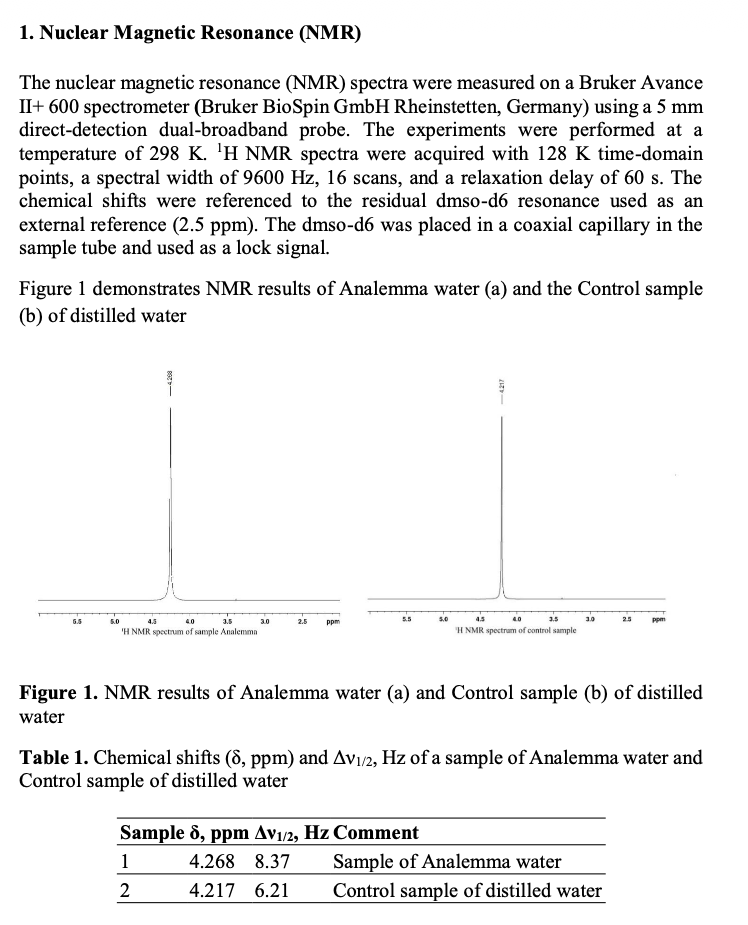
In the NMR section, a difference was measured between Analemma Water and the control sample. The signal of Analemma Water was measured at 4.268 ppm, while the control water was measured at 4.217 ppm. This difference indicates a change in the local molecular environment of the water protons.
The linewidth in the NMR measurement also differed. This may be related to differences in the dynamics of molecular interactions, such as how fast and in what way water molecules move with each other within the hydrogen bond network.
FR-IR (Infrared)
Water clusters and hydrogen bonds
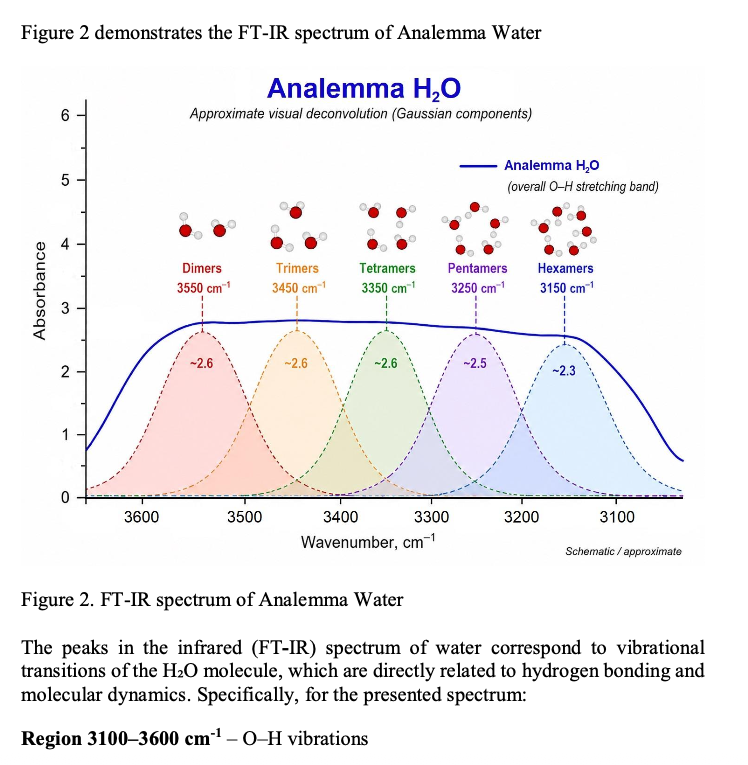
The FT-IR analysis showed that the region between 3100 and 3600 cm-¹ is especially important. This is the region in which the O-H bonds of water vibrate. The shape and width of this signal are associated in the study with different local environments of water molecules.
The model in the study describes structures that fit water clusters of two, three, four, five and six water molecules. This does not mean that water becomes stationary or solid, but rather that there is evidence of a dynamically organized structure in the hydrogen bond network.
What did the research show?
This study showed that distilled water showed measurably different spectral properties than untreated distilled water after 10 minutes of exposure to the Analemma Water Inlay.
The NMR results indicate a change in the local molecular environment and dynamics of water molecules. The FT-IR results support the picture of a structured hydrogen bond network with possible cluster formations.
Conclusion
The measurements show that Analemma Water behaved differently from the control water in this study.
The differences are not chemical in nature – it remains H₂O – but seem to lie in the arrangement, dynamics and mutual interaction of water molecules.
In other words, the study provides measurable evidence that the Analemma Water Inlay affects the structure and organization of water at the molecular level.
The NMR/FT-IR study included a chemical shift of 4.268 ppm versus 4.217 ppm and a linewidth difference of 2.16 Hz reported . The FT-IR conclusion links the 3100-3600 cm-¹ region to O-H vibrations, hydrogen bonds and possible cluster structures