
NAD+
Below is a summary of the study and observation we did in relation to the behavior of coherent water.
NAD+ (cellular support)
Stable coherent water shows measurable increase in NAD+ in a preliminary study
PARTICIPANTS:
10 healthy adult subjects aged 25 to 40 years. 9 participants completed the study. For NAD+ analysis, data from 9 participants in the placebo period and 8 participants in the Analemma Water period were included.
STUDY DESIGN:
Double-blind, balanced, randomized, two treatments, two periods. The study compared placebo drinking water with Analemma Water. Both participants and those involved in assessment and monitoring were blinded where necessary to reduce bias.
TREATMENT:
Participants drank a minimum of 1.5 liters of water per day. In period 1, participants received placebo drinking water from day 1 through day 30. After a wash-out period, participants in period 2 received Analemma Water from day 36 through day 96. Blood samples were collected at multiple time points for NAD+ analysis.
RESULTS:
In the placebo period, no significant change in NAD+ concentration was found. However, a significant increase was measured in the stable coherent water period compared to baseline. The mean NAD+ value increased in the Analemma Water period from 8372.76 to 10033.75, an increase of about 20%. The comparison between placebo and the stable coherent water was statistically significant.
SAFETY:
No serious adverse events were reported during the study. The reported adverse events occurred during the post-study safety assessment, were not attributed to the treatment periods and were completely resolved. Full spectrum coherent water was well tolerated in this study.
View the NAD+ Clinical Study
View the NAD+ Assay study & Preliminary Microbiome Study
NAD+ – an important link in cellular energy
In every cell, thousands of tiny processes take place continuously. Your body builds up, breaks down, repairs, communicates and constantly adapts. All these processes require energy, but also cooperation between all kinds of molecules. One of the important players in this story is NAD+.
NAD+ stands for nicotinamide adenine dinucleotide. That sounds complicated, but you can think of it as a kind of helper molecule involved in energy processes in the cell. Among other things, NAD+ plays a role in how cells get energy from nutrients and how certain cellular processes are regulated.
Why is NAD+ interesting?
NAD+ occurs naturally in the body. It is involved in the energy management of cells and is widely studied because of its role in mitochondria, the cell’s tiny energy factories.
Whereas ATP is often described as the cell’s direct “energy currency,” NAD+ is more of a silent helper behind the scenes. It assists in reactions involving the release and transfer of energy. Without this type of supporting molecule, cellular processes would run much less efficiently.
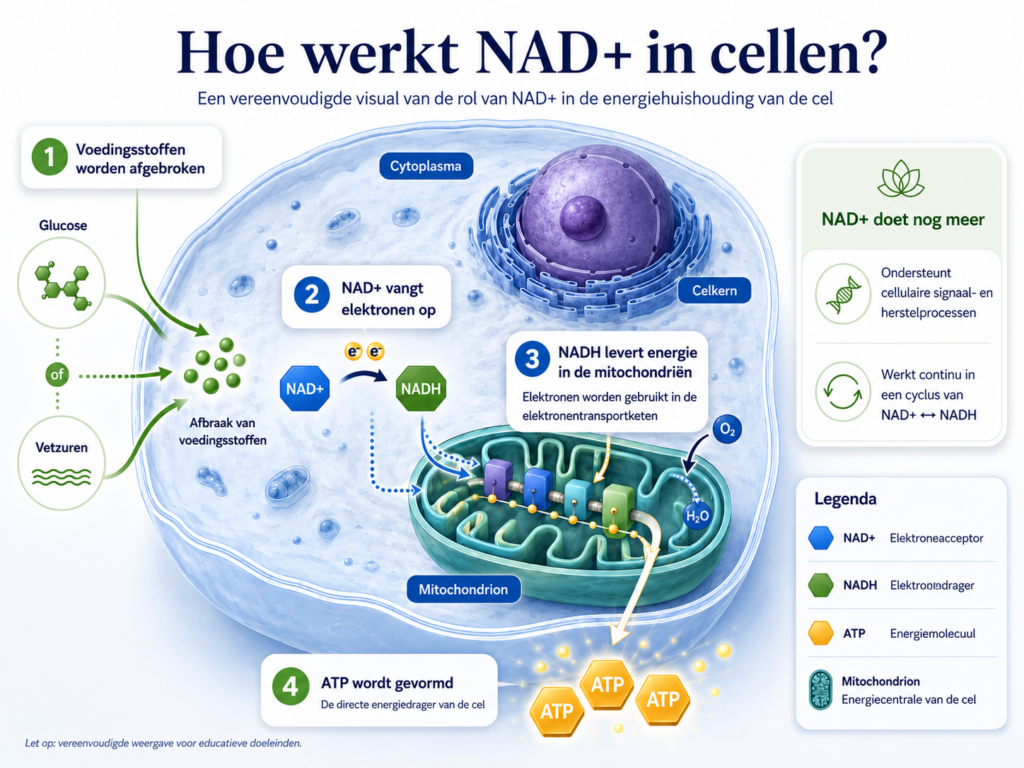
Index to the NAD+ visual
Nutrients enter the cell
The symbols on the left represent nutrients, such as sugars and fats. These are broken down into smaller building blocks in the cell.
1. NAD+ captures electrons
NAD+ acts as a kind of temporary receiver. It picks up electrons released during the breakdown of nutrients. Once NAD+ has picked up electrons, it turns into NADH.
2. NADH transports electrons to the mitochondrion
NADH transports electrons to the mitochondrion. This is the part of the cell where a lot of energy production takes place.
3. Energy is released in the mitochondrion
The electrons move through a series of steps in the mitochondrion. This involves oxygen and water in the process. This helps the cell form ATP.
4. ATP is the cell’s direct energy source
ATP can be thought of as the energy molecule that cells can use directly. It supports all kinds of normal cellular processes, such as movement, repair, communication and construction.
The cycle keeps going
NAD+ and NADH constantly switch forms: NAD+ takes up electrons, becomes NADH, delivers the electrons and then can return to NAD+. Thus, the energy cycle in the cell remains active.
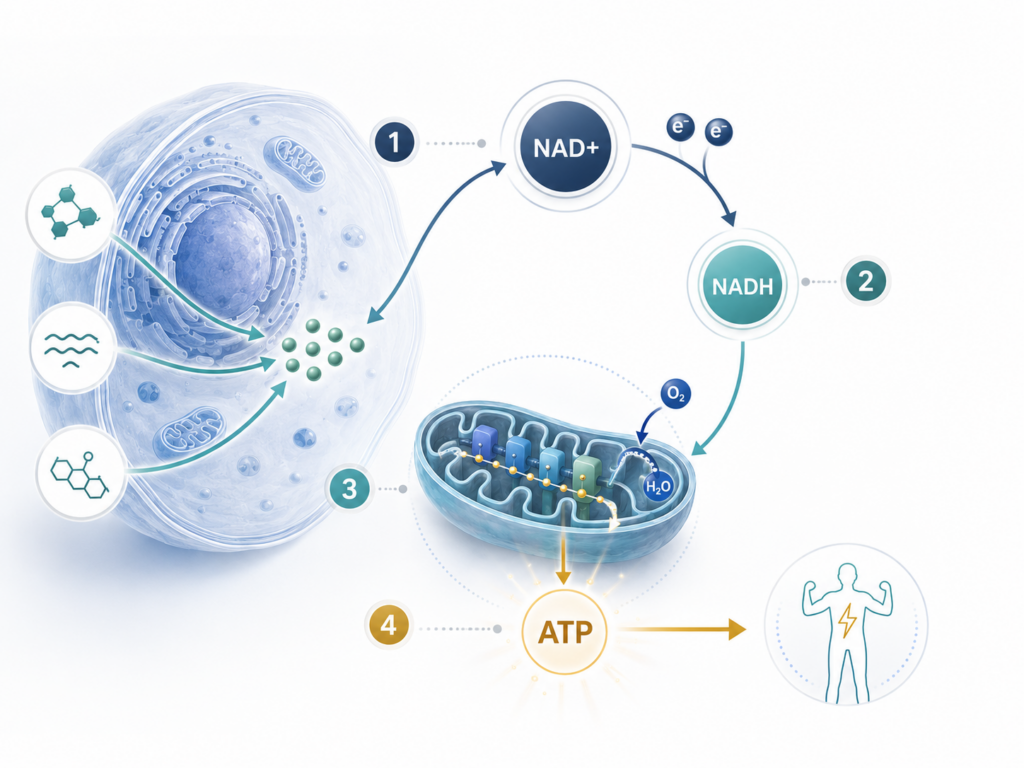
Meaning of the symbols
NAD+ A helper molecule that can absorb electrons.
NADH
The form of NAD+ after it absorbs electrons.
NADH brings these electrons to the mitochondrion.
e- Electrons. These carry energy information from the breakdown of nutrients.
Mitochondrion
The energy center of the cell.
This is where electrons are used to help form ATP.
O₂ Oxygen. Oxygen plays a role at the end of the energy process in the mitochondrion.
H₂O Water. This is created as part of the process in which electrons and oxygen are processed.
ATP The energy molecule that cells can use directly.
Arrow to the body Shows that the energy formed eventually becomes available for normal body and cell functions.The benefits of Full Spectrum Coherent Water
This preliminary study investigated whether drinking the stable, coherent water affected NAD+ concentration in whole blood. Participants drank water daily during the study according to a set protocol. The researchers compared measurements before and after the placebo period with measurements before and after the stable coherent Water period.
The outcome was striking: no significant increase was found during the placebo period, while a statistically significant increase in NAD+ was measured after the stable coherent water period. The comparison between placebo and full spectrum coherent water also showed a significant difference.
This does not mean that medical conclusions can be drawn. The study was small-scale and is described in the report itself as preliminary. However, it does show that under the conditions of this study, there was a measurable change in NAD+ concentration after drinking the full spectrum coherent water.
Conclusion
The NAD+ study shows that drinking Analemma Water in this small-scale, preliminary human study was associated with a significant increase in NAD+ concentration in whole blood. No significant change was measured in the placebo period, while the Analemma Water period showed an average increase of about 20%. The comparison between the two periods was statistically significant.
These results indicate an interesting and measurable effect of stable coherent water on an important marker involved in cellular energy processes. At the same time, additional research with larger groups remains necessary to further confirm and better understand this finding.