
The second brain
Gut health: the key to a healthy brain, a strong immune system and a happier life?
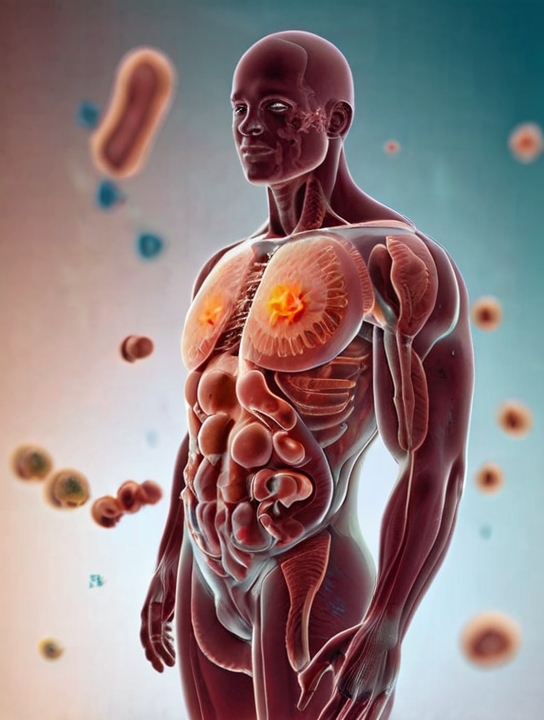
Our gut, often referred to as our “second brain,” plays a crucial role in our overall health and well-being.
The complex system of the intestines is closely connected to our nervous system, particularly the vagus nerve, which acts as an information highway between the brain and the intestines. This connection is critical for the regulation of various bodily functions and affects our mood and mental health.
In this article you will read how your gut health affects your overall health via the vagus nerve. So you can take back (more) control of your health.
The vagus nerve:
the communication bridge between the brain and the intestines

The effects of a disrupted microbiome on gut health
The importance of butyrate-producing bacteria for healthy gut flora
In addition to the diversity of the overall gut microbiome, the so-called butyrate-producing bacteria are also an important part of a healthy microbiome. These bacteria play a crucial role for our gut health and overall well-being (Marchesi et al., 2016).
Butyrate is a short-chain fatty acid produced by these bacteria. It not only serves as fuel for intestinal cells, but also has anti-inflammatory properties and can strengthen the intestinal barrier. Moreover, butyrate stimulates the production of serotonin, which has a positive effect on our mood and cognitive functions. Not surprisingly, people deficient in these bacteria often suffer from depressive symptoms.
It is therefore of great importance to promote the growth of butyrate-producing bacteria in our microbiome. One way to achieve this is through a high-fiber diet, probiotics and a healthy lifestyle. In addition, butter naturally provides this valuable fatty acid.
Coherent water and frequency therapy from Information Medicine stimulates the growth of butyrate-producing bacteria!
In our small-scale research, we have shown that stable, coherent water can increase the amount of butyrate-producing bacteria and improve the diversity of the microbiome. Both factors are important in combating an unhealthy gut wall, which often results from an unbalanced microbiome.
Another remarkable result was the pilot study investigating the effect of Information Medicine’s sound therapy in humans. Again, the conscious use of (sound) frequencies was found to have positive effects on the microbiome and thus on general well-being. Read more information here.

The consequences of a leaky gut: Understanding the consequences of an unhealthy lifestyle
A damaged intestinal wall, also called leaky gut, can cause unwanted substances and particles to enter the bloodstream.
This, in turn, can cause a chain reaction of inflammation and immune system overload (Camilleri et al., 2012).
A leaky gut is associated with a wide range of health problems, ranging from digestive disorders (Fasano, 2020) and skin conditions to autoimmune diseases (Mu et al., 2017).
Moreover, the connection between the intestines and the brain via the vagus nerve can cause these inflammations to also affect the brain, leading to neurological or psychological problems (Carabotti et al., 2015).
It is therefore crucial to keep the intestinal barrier healthy and address the underlying causes of leaky gut.
Nutrition and lifestyle: key factors for a healthy gut
A high-fiber diet with plenty of vegetables and fermented foods is essential for healthy gut flora.
Avoiding processed foods, sugar and artificial additives can help maintain the diversity of gut bacteria.
In addition, factors such as adequate sunlight (preferably as early as dawn) play a role. Grounding (touching the ground with bare feet), regular exercise, adequate sleep and stress management play a crucial role in supporting healthy gut function.

Conclusion:
The fascinating connection between gut health and well-being
Gut health is a complex and fascinating subject that has a profound impact on our overall well-being.
When it is understood that the gut is our “second brain” and constantly communicates with the brain via the vagus nerve, it becomes clear how important a healthy gut flora is.
With this, we can not only prevent or cure leaky gut syndrome, but also actively improve our gut health (Belkaid and Hand, 2014).
With proper nutrition, a healthy lifestyle and attention to the vagus nerve, we can improve our gut health and quality of life.
Literature List
Belkaid, Y., & Hand, T. W. (2014). The role of the microbiota in immunity and inflammation. Cell, 157(1), 121-141.
Breit, S., Kupferberg, A., Rogler, G., & Hasler, G. (2018). The vagus nerve as a modulator of the brain-gut axis in psychiatric and inflammatory disorders. Frontiers in psychiatry, 9, 44.
Canani, R. B., Costanzo, M. D., Leone, L., Pedata, M., Meli, R., & Calignano, A. (2011). Potential beneficial effects of butyrate in intestinal and extraintestinal diseases. World Journal of Gastroenterology: WJG, 17(12), 1519.
Carabotti, M., Scirocco, A., Maselli, M. A., & Severi, C. (2015). The gut-brain axis: interactions between the gut microbiota, the central and enteric nervous systems. Annals of Gastroenterology, 28(2), 203.
Camilleri, M., Madsen, K., Spiller, R., Van Meerveld, B. G., & Verne, G. N. (2012). Intestinal barrier function in health and gastrointestinal diseases. Neurogastroenterology & Motility, 24(6), 503-512.
Dinan, T. G., & Cryan, J. F. (2017). The microbiome-gut-brain axis in health and disease. Gastroenterology Clinics, 46(1), 77-89.
Fasano, A. (2020). All disease begins in the (leaky) gut: the role of zonulin-mediated intestinal permeability in the pathogenesis of some chronic inflammatory diseases. F1000Research, 9.
Marchesi, J. R., Adams, D. H., Fava, F., Hermes, G. D., Hirschfield, G. M., Hold, G., … & Hart, A. (2016). The gut microbiota and host health: a new clinical research area. Gut, 65(2), 330-339.
Mu, Q., Kirby, J., Reilly, C. M., & Luo, X. M. (2017). The leaky gut as a danger signal for autoimmune diseases. Frontiers in immunology, 8, 598.
Thursby, E., & Juge, N. (2017). Introduction to the human gut microbiota. Biochemical Journal, 474(11), 1823-1836.
Valles-Colomer, M., Falony, G., Darzi, Y., Tigchelaar, E. F., Wang, J., Tito, R. Y., … & Raes, J. (2019). The neuroactive potential of the human gut microbiota for quality of life and depression. Nature Microbiology, 4(4), 623-632.